

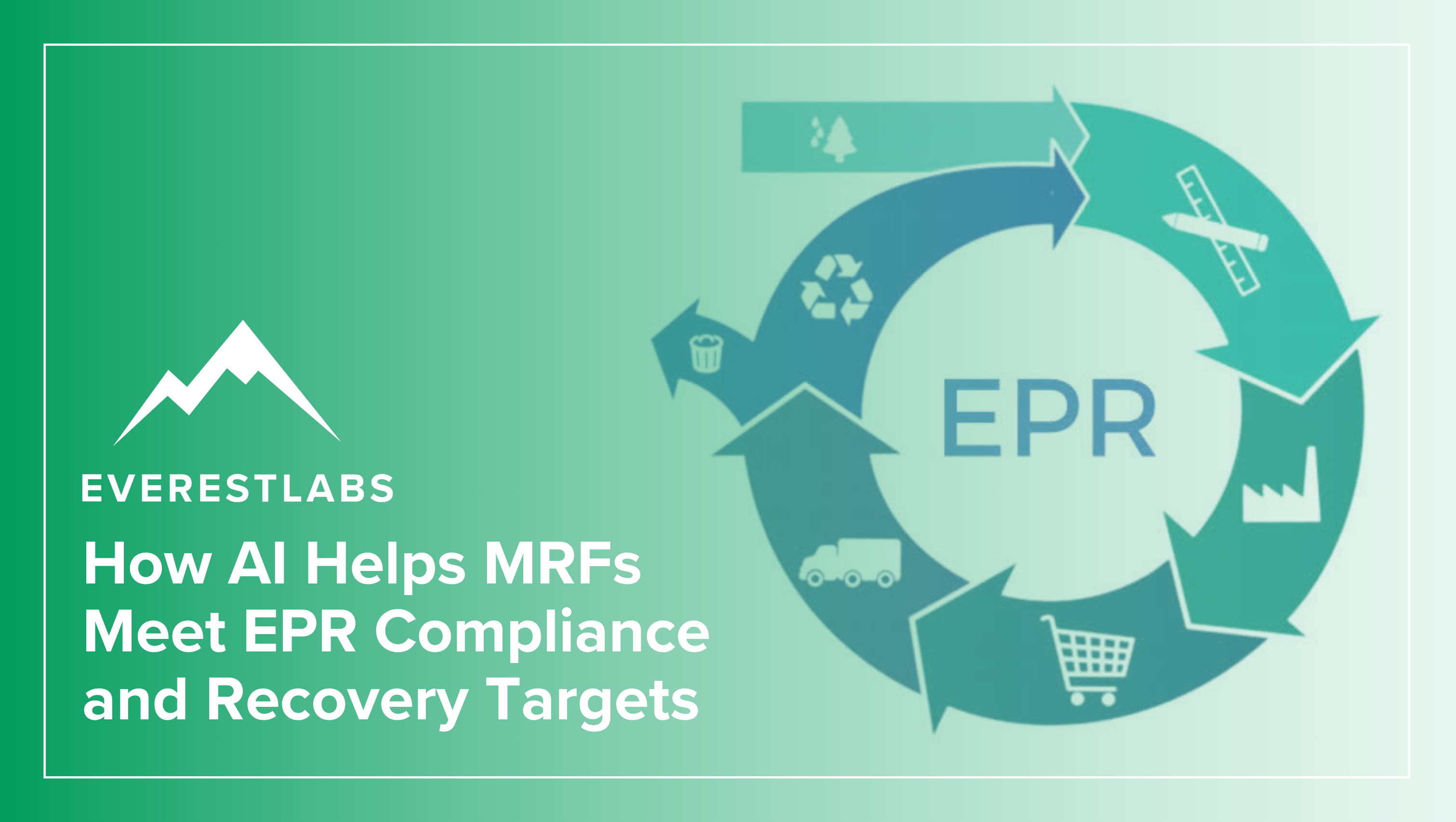
Extended producer responsibility (EPR) is changing what a recycling facility has to prove, not just what it has to sort. At RCon in St. Louis, our Chief Product Officer, Apurba Pradhan, laid out how EPR will reshape MRF operations and why AI vision is becoming the tool facilities use to keep up.
EPR shifts the cost of recycling and waste management of packaging products onto the brands that make and sell them. Brands fund programs run by producer responsibility organizations (PROs), which manage funds and set accepted materials lists, recovery targets, and reporting rules under state oversight. The goal is to encourage more sustainable packaging and fund a more efficient recycling system.
But EPR doesn’t just affect producers of packaging. Material Recovery Facilities (MRFs) will also face significant changes under this new policy. For MRFs, EPR affects them in two main ways. First, everything must now get documented: recovery rates, residue rates, composition, and where every bale ends up. This must be reported on a schedule and open to audit. Yet most facilities still audit by hand, pulling a 50- to 100-pound sample and sorting it into bins. That takes about half an hour and captures only around 0.01% of a day's material, a thin basis for state reporting or a bale-quality dispute with a mill.
Second, MRFs will be facing higher recovery targets across a broader range of packaging formats. Recovery targets are climbing, and accepted materials lists, which already span about 13 material classes and 70 subclasses, are adding film, cartons, and other materials most MRFs have never processed. They will need to invest in new technologies and facility upgrades to meet these standards.
Vision AI measures what's on the belt, robotic sorters recover it, and agentic AI helps operators optimize the line. Here's how these technologies can help MRFs respond to EPR requirements.
Audits that count everything, not a sample.
Vision AI records and classifies objects moving across the belt, providing continuous measurement instead of relying solely on manual hand sorts that capture a small sample of material.
On one fiber line, it tracked bale purity at 91.27% over seven days and broke down the remaining contaminants by PET, PP, HDPE, and aluminum. This level of detailed data can help MRFs document material quality, support state reporting, and resolve disputes with mills.
Cameras at the infeed and end of line can also provide a daily account of tons received, recovered, and landfilled, giving operators better data to evaluate performance against EPR requirements.
Robotic sorting that recovers what's on the list.
As EPR programs evolve and accepted materials lists expand, MRFs need to identify and recover packaging formats that existing sorting processes may miss. Vision-guided robots can be trained to recognize and pull targeted materials, helping facilities capture the materials on the statewide material lists.
Agentic AI that helps MRFs meet recovery targets.
Identifying materials is only the first step. MRFs also need to understand what they recover, what they miss, and how operational changes can improve performance. EverestLabs Navigator, an agentic AI assistant for plant operators, analyzes facility data to identify bottlenecks, underused capacity, and opportunities to recover more material.
For example, tracking aseptic cartons through one facility revealed that many were ending up on the aluminum and PET lines instead of being recovered separately. The facility now uses a robot to recover them. Operators can also ask how a disc screen is separating 2D and 3D materials and receive step-by-step guidance on disc speed, feed rate, and screen angle to help reduce missorts of targeted commodities.
By turning facility data into actionable recommendations, Navigator helps MRFs improve recovery and material quality, two increasingly important priorities as EPR programs raise expectations for packaging recovery, material traceability, and performance.
PROs are already purchasing AI vision systems and testing them in their own labs. Once they’re confident in the technology, Apurba Pradhan expects them to ask MRFs to install these systems and potentially help fund the investment.
For MRFs, the time to prepare is now. Facilities that establish a strong data foundation today will be better positioned to meet emerging EPR reporting requirements, demonstrate recovery performance, and respond to PRO expectations as programs evolve.
Want to see what object-level data could reveal about your facility? Talk to the EverestLabs team to explore how AI can help your operation prepare for EPR.
*Apurba Pradhan’s RCon presentation was covered by Resource Recycling in “EPR demands push AI vision systems toward MRFs” (October 6, 2026).