Introduction to Recycling Sortation
The recycling industry is at a critical juncture, grappling with mounting challenges that threaten its sustainability and efficiency. From escalating labor costs and high contamination rates to the ever-present demand for increased productivity, materials recovery facilities (MRFs) are under immense pressure to adapt and innovate. Imagine a world where these facilities could operate around the clock, with unwavering precision and a workforce that never tires – a world where robots join forces with human expertise to revolutionize the way we recycle. At EverestLabs, a leading climate tech company, we are turning this vision into reality by developing cutting-edge AI software and robotics solutions tailored specifically for recycling plants and MRFs.
Human Sorters
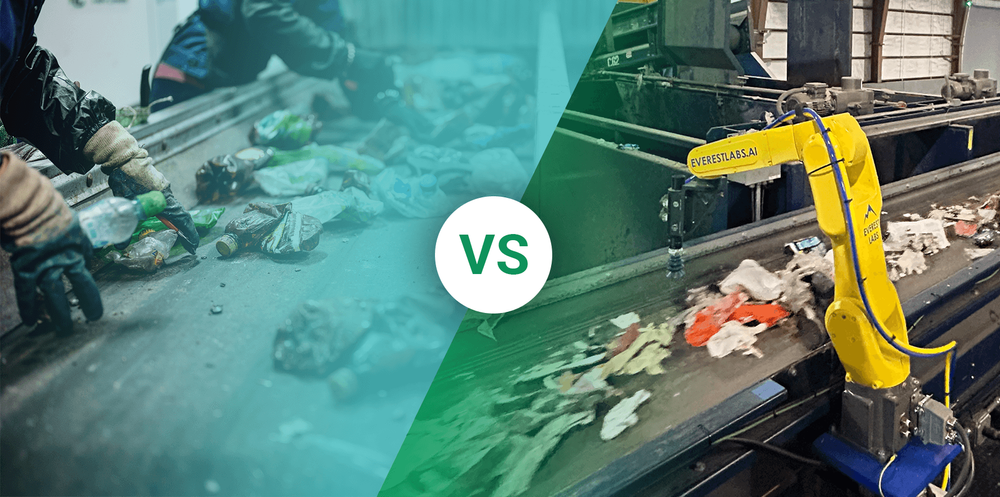
Traditionally, the human workforce has been the backbone of recycling operations, with individuals diligently sorting through mountains of recyclables at MRFs. These tasks are not only physically demanding but also fraught with safety risks. Envision standing for hours on end, meticulously sifting through a rapidly moving conveyor belt laden with sharp objects, hazardous materials, and heavy items. The constant stress on the body, coupled with the potential for injuries, creates a taxing work environment. Further, the limitations inherent in human speed and accuracy often lead to bottlenecks in processing recyclables effectively and lower return for operators. Humans will do about 40 picks per minute and will get tired, compounded by labor shortages, training, and high turnover rate.
Robotic Sorters
Robotics in recycling brings a new level of operational efficiency while mitigating the challenges faced by human workers. MRF operators have reported that using robots in place of humans has allowed personnel to move into higher-priority positions, which is a win for team members and plant safety.
Here are some of the key advantages of incorporating robots into the recycling operations:
- Always-On Capability: Unlike human workers, robots can operate continuously, 24/7, with an impressive performance uptime of 99%. This continuous operation translates into increased productivity and higher throughput for MRFs.
- Sorting Capabilities: Robots are capable of sorting a wide variety of materials at impressive pick rates, significantly improving overall sorting efficiency. On average, human workers can pick out about 40 recyclable materials per minute from a waste stream. However, human efficiency tends to decline throughout the day due to fatigue and other factors. In contrast, recycling robots can maintain a steady rate without declining performance. Here at EverestLabs, our computer vision system and machine learning algorithms enable accurate and rapid identification and separation of recyclables, surpassing the capabilities of manual sorting.
- Payback Period: Using robots, MRFs can expect the cost of leasing a robot to closely align with the salary of a human sorter, achieving payback immediately or within a few months of installation. Additionally, the recycling plant benefits from increased revenue due to improved efficiency in material recovery, reduced labor costs, and savings on landfill fees. With EverestLabs robots, MRFs typically experience up to 70% reduction in labor costs, 2x increase in material recovery, and 40-70% reduction in landfill fees.
- Quality Control and Monitoring: AI and robotics software can be monitored to ensure optimal performance and system health. This greatly benefits the MRF operator as the technology enables real-time adjustments in the sorting process and alerts team members if any issues arise. For example, EverestLabs offers 24/7 monitoring of their robotics and AI system, RecycleOS, promptly notifying the MRF operator if any issue arises and allowing for real-time adjustments and optimization of the sorting process.
- Weather Resilience: Robots are engineered to sustain weather and environmental conditions found in recycling facilities with temperatures ranging from 0 to 40 C. EverestLabs’ systems have been deployed in various locations with different weather conditions, such as Minnesota, Ohio, and New York. Additionally, air conditioning units are installed in all compute boxes to ensure peak performance in warmer environments.
- Simple Installation: Robot installation is generally simple and straightforward, ensuring the necessary infrastructure is in place, including hardware, electrical outlets, Internet connection, vision system, and a safety cage placed around the robot.
- Minimal Maintenance: Robot maintenance is minimal with the suction cup occasionally needing to be cleaned or replaced which can be done by the recycler operator with ease.
Humans Managing Robots
The integration of robotics in recycling does not eliminate the need for human intervention; rather, it reshapes the roles humans play. With industrial robots taking on repetitive and hazardous tasks, human workers transition to supervisory, maintenance, and quality control roles. This synergistic relationship between humans and robots not only enhances the workplace environment by reducing physical strain and exposure to harmful substances but also elevates the overall operational efficiency of MRFs.
Learn more about EverestLabs’ technology and how we help recyclers increase revenue, lower labor costs, and boost recycled content by checking out our Videos page.
Ready to elevate your recycling operations? Give us a shout.