In many parts of the world, local governments and citizens are responsible for recycling. But that’s changing with Extended Producer Responsibility (EPR), which shifts the responsibility to consumer brands. EPR requires producers to manage their packaging’s entire lifecycle—from production to disposal. The goal is to encourage more sustainable packaging and fund a more efficient recycling system.
EPR has been implemented in countries around the world and has shown impressive results. In Germany, recycling rates for packaging jumped from 37.7% to 76.2% after EPR legislation was introduced, nearly a 40% increase. The Netherlands saw a 36% increase in recycling plastic within just three years. Despite its global success, the U.S. is still catching up, though states like California, Colorado, Minnesota, Oregon and Maine have already passed EPR laws.
The need for EPR is clear, as 71% of the world’s waste comes from products and packaging, with millions of tons ending up in landfills annually. By redesigning packaging and driving innovation, EPR can help recover valuable materials, reduce landfill waste, and improve stagnant recycling rates in the U.S.
EPR doesn’t just benefit the environment—it also boosts the economy. According to a study, states that adopt EPR can generate over 200,000 jobs, strengthen recycling supply chains, and create billions in economic benefits, all while reducing public spending on waste management.
Both the recycling industry and consumer brands will feel the impact of EPR. Recycling facilities will need to meet higher recovery targets and reduce contamination in their outgoing bales of materials. They will also have to increase the number of material audits they do to make sure they are meeting these new requirements.
Consumer brands will also face meeting certain targets. One of these targets is recycled material content requirements for packaging, otherwise known as post-consumer resin (PCR) requirements. Under this requirement, brands must incorporate a certain percentage of recyclable material in their packaging. PCR requirements are either addressed specifically in the legislation, like in Minnesota, which requires 10% of PCR to be used in packaging by 2033, or they are addressed under ecomodulation.
Ecomodulation is a fee structure that calculates how much brands will have to pay for the disposal of their packaging. When using ecomodulation, producers using less eco-friendly materials will face higher fees, while those embracing recyclable or reusable packaging will pay less. It is essentially a financial incentive for brands to design and utilize more sustainable packaging.
It is imperative for Material Recovery Facilities (MRFs) to digitize and accurately analyze their recycling streams in today’s rapidly evolving recycling landscape. With the ability to identify 50 classes of objects with over 95% accuracy, AI-powered systems can also adapt to new material types within just two weeks of training. As EPR continues to develop, MRFs must sort and process an increasing variety of packaging types. The flexibility of AI models ensures that MRFs can stay ahead of advancements in packaging materials and meet the ever-evolving minimum recyclables lists set by EPR legislation.
AI uses up-to-date recycling market pricing data to offer valuable insights into the composition and value of items that would otherwise be lost to landfills. This capability will become crucial as EPR mandates increase recovery rate standards for MRFs. Robotics, in conjunction with AI, can help boost recovery rates, allowing facilities to meet and exceed these new benchmarks. Additionally, AI technology enables real-time monitoring of plant performance, allowing operators to track and compare performance by shift or across the entire plant. Facilities can measure sorting efficiency and recovery rates for all material types, optimizing strategies for better outcomes.
Bale audits are another key area where AI plays a transformative role. The accurate measurement and tracking of bale materials, as well as monitoring contamination levels, are critical for both MRFs and recyclers under EPR. This data informs how facilities can adjust their sorting processes to improve recovery rates and reduce contamination. While most bale audits are performed manually today—an often time-consuming and potentially inaccurate process—AI offers an automatic, real-time, and continuous alternative. By placing AI systems on residue or bale lines, MRFs gain unparalleled visibility, providing stakeholders with reliable, cost-effective audit data that can streamline operations and enhance compliance with EPR standards.
Understanding the recyclability of your packaging and ensuring it is recovered at a recycling facility will be crucial for meeting both sustainability goals and EPR requirements. ‘
EverestLabs’ AI and robotics solution, RecycleOS, enables the identification and recovery of brand-specific packaging, providing companies with valuable insights into the recyclability of their packaging materials. We also offer essential data for audits, ensuring that companies meet their environmental goals and regulatory requirements. By leveraging this data, brands can assess the recyclability of their products on both local and regional levels, gaining a clearer understanding of their packaging’s lifecycle. This visibility allows them to optimize packaging designs for improved recovery rates, contributing to a more sustainable future and reducing their fees under EPR.
In addition to providing data, EverestLabs robotics technology plays a key role in enhancing recovery efforts by efficiently targeting and retrieving brand-specific packaging. These robotic systems can be easily integrated into existing belts in recycling facilities without the need for major retrofits, making the transition smooth and cost-effective. The consistent performance of these robots ensures higher recovery rates, often exceeding traditional sorting methods.
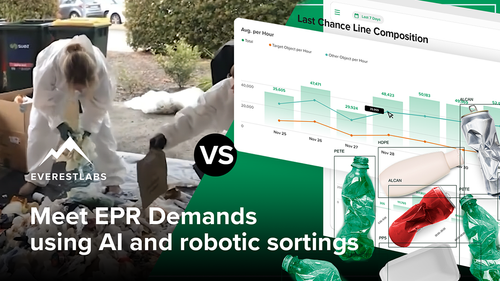
Watch our video for more details on how EverestLabs can help your facility or brand excel under EPR!
Get in touch with an expert to learn how much you could recover off your last chance line or send us an email at hello@everestlabs.ai.