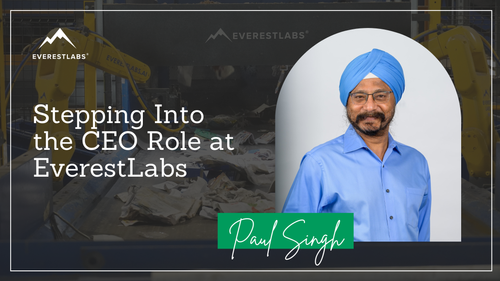
My journey with the EverestLabs didn’t begin yesterday. I was an early investor and advisor, watching from the front row as the team tackled one of the most complex operational challenges on the planet. So when the founder and board approached me about leading EverestLabs into its next chapter, the decision became clear.
Here’s why I said yes.
At EverestLabs, we are not building AI for the sake of hype. We are building technology that solves real operational problems for the recycling industry.
Every system we deploy helps recycling facilities recover more valuable materials, reduce contamination, lower carbon impact, address labor shortages, and create safer environments for workers. The work we do directly influences how efficiently materials are recovered and reused—and that has meaningful implications for both our industry and our planet.
That mission matters deeply to me.
I’ve spent years around emerging technologies and have seen countless waves of AI enthusiasm. What drew me to EverestLabs is that we are focused on useful AI. AI that operates in the real world under difficult conditions and delivers measurable outcomes.
Recycling facilities are among the most demanding industrial environments imaginable. They are high-speed, chaotic, highly variable, and constantly changing. Building AI systems that can thrive in those conditions is incredibly difficult.
That’s exactly what makes this opportunity so exciting.
At EverestLabs, we are developing physical AI systems that combine computer vision, robotics, and real-time decision-making to enable operators to understand and manage their facilities with real-time operational intelligence. These systems are deployed directly at the edge, where decisions need to happen instantly and reliably.
We are building physical AI systems that give recycling facilities superhuman sorting and operational visibility capabilities—transforming dangerous, manual workflows into autonomous, data-driven operations.
While much of the industry talks about AI in theory, our team is deploying it every day in some of the most demanding and difficult industrial environments in the world.
And this is only the beginning.
Our broader vision is to create the blueprint for industrial autonomy. If we can solve the complexity of a recycling facility, we can extend these capabilities into manufacturing environments across industries.
What ultimately convinced me to step into this role wasn’t only the technology. It was the people behind it.
The EverestLabs team has built an extraordinary culture centered around customer success. This is a group that operates with urgency, commitment, and accountability. They are deeply invested in helping customers succeed and are willing to do whatever it takes to support plant operations around the clock.
That kind of customer-first mindset is rare, and it creates trust that technology alone cannot.
As we move into this next phase of growth, that culture will remain central to who we are.
To our customers, partners, investors, and the incredible EverestLabs team: thank you for believing in this mission.
I’m excited for what we are going to build together as we continue making recycling smarter, safer, more autonomous, and more sustainable.
The future of physical AI is being built now, and I believe EverestLabs is uniquely positioned to lead it.