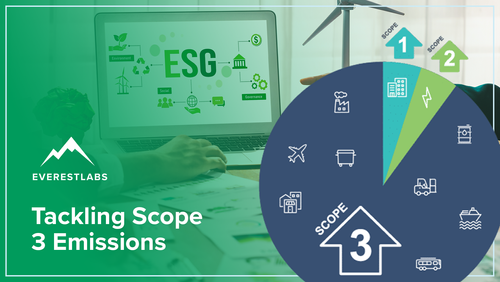
Scope 3 emissions refer to indirect emissions that stem from activities not owned or directly controlled by the reporting organization but within its value chain, either upstream or downstream. Simply put, these emissions are produced by a company's extended operations and external partners, such as suppliers. Because they extend beyond the boundaries of a company's direct operations, Scope 3 emissions are more difficult to track and measure than Scope 1 (direct emissions from owned sources) and Scope 2 (indirect emissions from purchased energy).
Scope 3 emissions often account for most of an organization's total emissions, making them the most impactful in terms of an overall carbon footprint. For consumer packaged goods (CPG) companies, Scope 3 emissions typically account for 75%-95% of the company's overall footprint. Therefore, tackling Scope 3 emissions is a significant way for businesses to reduce their environmental impact and meet sustainability goals.
Waste generation and disposal plays a significant role in a company’s Scope 3 emissions. Focusing on increasing the circularity of products and packaging helps by reducing waste sent to landfills and the energy consumption of making new packaging with virgin materials. Implementing proper waste management practices like waste segregation, composting, reuse, and recycling into operations and adopting sustainable packaging can help companies achieve circularity and reduce their emissions.
Waste generation and disposal are key contributors to a company’s Scope 3 emissions. Companies can tackle some of their waste-related Scope 3 emissions by optimizing recycling processes and boosting recycling rates of their products and packaging.
Recycling and circular economy solutions offer significant potential for reducing emissions across the entire supply chain, from upstream material sourcing to downstream product disposal. When businesses divert waste from landfills by recycling, they mitigate the environmental impact of their waste while fostering a more sustainable, circular economy for their packaging.
To help ensure their packaging is recycled, businesses can invest in advanced sorting technologies, like AI and robotics, to help recover their materials at a recycling facility. Additionally, educating employees and customers on the importance of recycling their packaging and products can substantially improve recycling outcomes.
EverestLabs’ AI and robotics solution, RecycleOS, can be placed in recycling facilities to identify and recover brand-specific packaging while providing companies with vast amounts of data about the recyclability of their packaging. Our robotics can increase packaging recovery in recycling facilities, reducing the amount sent to landfill, and strengthening the circular economy for packaging. Additionally, the data collected can be used to optimize packaging design to ensure it is properly recovered in a recycling facility. We also offer auditable reports on sustainability metrics, including GHG reductions and energy savings, providing valuable insights for Scope 3 emissions reporting.
By prioritizing circular practices, companies can cut end-of-life emissions by using recycled materials, reducing landfilling of their products, and securing recycled raw materials for future production. This, in turn, decreases the demand for virgin resources, thus minimizing upstream emissions associated with the extraction, processing, and transportation of raw materials.
Companies can sidestep the greenhouse gas emissions generated by using recycled content instead of virgin materials in packaging. This shift helps reduce emissions and moves industries closer to a more sustainable, circular production model that prioritizes resource conservation and emissions reduction.
Right now, high-quality recycled content (PCR) for packaging is more expensive than virgin materials. This makes it difficult for companies to justify switching from virgin materials to PCR for packaging. This issue can be addressed by enhancing sorting efficiency within recycling facilities. Integrating RecycleOS into MRFs and reclaimer operations can significantly boost the capture and supply of recycled content for reusable packaging, supporting a stronger circular economy. When implemented in recycling facilities, RecycleOS can increase material recovery rates by 2-3 times compared to traditional sorting methods. Through AI and robotics, it becomes more cost-effective for companies to adopt post-consumer recycled (PCR) packaging and achieve their Scope 3 targets.
Reducing packaging, opting for low-impact materials, or redesigning products with minimal packaging can help lower emissions tied to both the production and disposal phases. Improving the recyclability of packaging materials can also significantly reduce emissions associated with product disposal and waste treatment.
Take a look at how we partnered with Can Manufacturers Institue and Crown Aragh to fund a RecycleOS system at LRS’ Chicagoland MRF, The Exchange. Our RecycleOS robot is slated to sort over a million cans otherwise headed to the landfill. These types of partnerships are invaluable to help recover more materal and reduce emissions across the board. Visit our Packaging Manufacturers page or reach out to us at hello@everestlabs.ai to learn more!