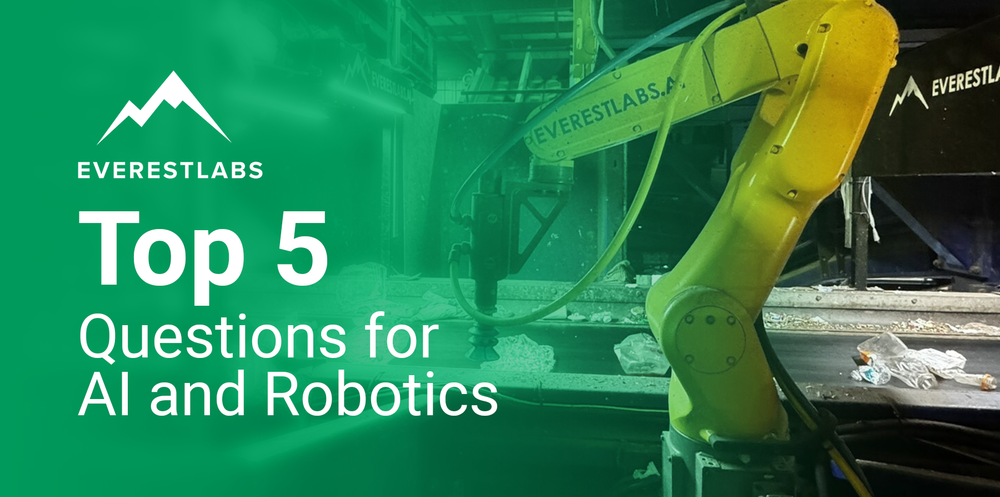
In the rapidly evolving landscape of recycling operations, the integration of AI and robotics has become a game-changer, promising to enhance efficiency, decrease labor costs, and significantly increase material recovery. However, the decision to implement such advanced technologies comes with its own set of challenges and considerations. Whether you are a small-scale recycler or a large corporation, knowing the right questions to ask before taking the leap is crucial. Here are the top 5 questions you should ask before implementing EverestLabs AI and robotics.
RecycleOS automates sorting at recycling facilities; most common sorting applications for robots include last chance recovery on residue lines, clean up at QC (quality control) locations, and clean up before balers. It is pivotal in recovering misdirected and unsorted items and cleaning up saleable commodities in last chance and QC lines respectively. Additionally, MRFs and reclaimers/reprocessors are using AI and robotics to enhance their baling operations, feedstock sorting, and specialized tasks including eliminating flexible plastics, separating batteries, and isolating brand packaging for Extended Producer Responsibility (EPR) and other required reporting. AI vision systems placed after other sorting machinery such as optical sorters or eddy currents help recycling facilities ensure that all machinery is working optimally. The data reported by the AI platform will inform the plant manager if a machine needs to be repaired or worked on to increase materials recovery.
Our robotics and AI system is designed for flexibility and can be mounted in inclined or space-constrained locations, where humans and other robotics cannot fit. The robots require no more than 3x3x7 ft of space and can be installed on any belt - inclined, raised, or cleated. Installation is quick and cost-effective, requiring no expensive retrofits, and is completed within a couple of hours to avoid any plant downtime.
The setup and deployment process for installation first involves ensuring the necessary infrastructure like electrical outlets, compressed air supply, and internet connection are in place. Once on-site, the team begins with the vision install, which includes mounting a vision system frame with a camera attached to identify materials on the conveyor belt. For robot installation, a robot pedestal is installed and the robot is mounted on it. A safety cage is placed around the robot to prevent access while functioning. See our deployment webinar here.
Unlike other sorting technologies, RecycleOS is designed for simplicity and ease of use. The only maintenance MRF operators need to complete is switching out suction cups as needed and cleaning the end of arm tool weekly. This maintenance is extremely simple and easy, and the suction cups are switched out when they are worn out or have any noticeable damage. Additionally, basic training is provided to on-site maintenance teams post-deployment, along with a basic maintenance kit for their convenience. Check out our maintenance video here.
At EverestLabs, the cost of leasing our system closely aligns with the cost of employing a human sorter, making it feasible for recyclers of any size to lease our system. In addition, this cost alignment enables our customers to achieve payback periods, calculated solely against hard costs, in as little as 3 months for multi-shift plants. Depending on the labor costs in a region, you could see immediate payback when deploying RecycleOS. See our blog article on ROI & payback and watch our webinar on our payback period.
Additionally, grants are available to fund a robot and vision system in your facility. In fact, one of our customers, Caglia Environmental, was able to secure a grant from Can Manufacturer’s Institute (CMI). Check out the case study, New Industry Partnership Increases UBC Recovery at Caglia Environmental, which highlights the grant. Another customer, LRS, secured a grant from CMI to fund a RecycleOS system at their Chicagoland facility, The Exchange. Learn more here LRS Advances Aluminum Can Recovery with EverestLabs Robot, Funded by Can Manufacturers Institute.
EverestLabs operates the robotics and provides 24/7 remote monitoring with our Robotic Operation Center (ROC). The ROC conducts continual audits to track robot performance and health, alerts if any housekeeping is required, remotely troubleshoots any issues seen, and ensures the accuracy of AI models over time. The ROC helps eliminate downtime and allows for proactive maintenance and adjustments to optimize robot performance.
Customers are also provided with a customer success rep to address any other issues or dispatch onsite support.
Ready to level up your recycling operations? Contact us to book some time with an expert.