

On September 30, 2026, Anthropic published one of the most rigorous attempts yet to answer a question every Physical AI founder gets asked: what work can robots actually do today, and what will it cost? Its study puts recycling near the very top of the list. I agree with the conclusion that the recycling industry is ready for robots; however, Anthropic’s argument is incomplete and needs to take a more nuanced look at the sector to determine the real-world value of robotics.
Before I offer my view, it is worth laying out what Anthropic found and why, in its own terms.
Anthropic's economics team, in a September 30, 2026 study by Russell Legate-Yang and Maxim Massenkoff, mapped robot capability against nearly 19,000 task descriptions across about 900 U.S. occupations. Claude searched for real robots performing each physical task and had to cite deployments, sales or demonstrations, not lab promises.
Each task was graded by how much structure a robot needs to do it:
The headline numbers are striking:
The core insight is the gap between can and pays. Capability is broad. Economics is the bottleneck.
Anthropic's rule of thumb: physical work gets automated first where robots already have a foothold. Its ten most exposed occupations are almost all vehicle and equipment operators, with Recycling and reclamation as the only exception.
Most exposed occupations
Source: Anthropic, Figure 4. Top 10 occupations with at least 20,000 jobs; employment from BLS (2025).
When. Anthropic is careful not to give industry deadlines. At historical cost declines of about 3% a year, it takes 40 years for robots to be cost-competitive for 10% of work, and until 2085 for half of today's physical work. In a fast scenario, with costs falling up to four times faster, that half arrives by 2050.
Why so slow. Cost is the most common barrier. Capabilities, mostly manipulation, limit about 70% of physical tasks. Regulation blocks 14%, and human preferences hold back about a quarter. Exposure, Anthropic stresses, is not displacement.
Anthropic priced robots for five physical occupations, and only hand packers clear the bar today. Recycling wasn't in that figure but its economics vary by location, number of shifts, material availability and insurance premiums.
Recycling and reclamation is the only occupation in Anthropic's top 10 that isn't operating a vehicle or machine, and the largest by employment. Robots can perform more than three-quarters of its working time at the E2 level, and only 8% is unexposed.
Anthropic's reasoning is that robots with computer vision and suction grippers already "sort materials, such as metals, glass, wood, paper or plastics, into appropriate containers for recycling." As the paper puts it: "These robots stand in for workers picking recycling from conveyor belts."
It also makes a prediction worth noting: "the largest recycling facilities use robots early, while smaller facilities adopt them later."
The cited evidence is a single company: the "AMP Robotics sorting robot," backed by a 2023 Waste360 interview with AMP's founder.
On the big picture, Anthropic is right. Recycling is one of the clearest near-term cases for Physical AI. The work comes to the robot on a conveyor. The task repeats thousands of times a shift. Every recovered item has commodity value. And the jobs are hard to staff.
Anthropic's evidence for recycling robots rests on AMP, using a 2023 interview. That snapshot is out of date, and the company's path since then is the most telling data point in our industry.
AMP has moved away from selling robots into existing plants and toward designing, building and operating entire MRFs:
That is a rational strategy for AMP. But it changes what the evidence says.
First, the cited supplier left the market Anthropic describes. The study models robots that "stand in for workers" on existing conveyor lines. The company it cites decided the better business was to build and run the plant. Whether this was a good decision or not, it merely reflects a company that pivoted out of it and not a reflection of the market potential.
Second, it understates the brownfield opportunity. There are hundreds of MRFs running in the U.S. today. Most will not be rebuilt for a decade or more. A greenfield, operator-owned MRF strategy addresses only a small slice of those plants. The near-term question for Physical AI is how much value can be unlocked in facilities already running.
Third, it gets the adoption curve backwards. Anthropic suggests the largest facilities adopt robots first and smaller ones later. In practice, retrofit robotics often lands first in mid-size plants, where labor gaps are acute and a few sorting positions move the P&L. The biggest new-build plants are a different market altogether.
None of this undermines Anthropic's central finding. It sharpens it. Recycling is ripe for robots, but the evidence base should reflect who is actually putting robots on today's lines.
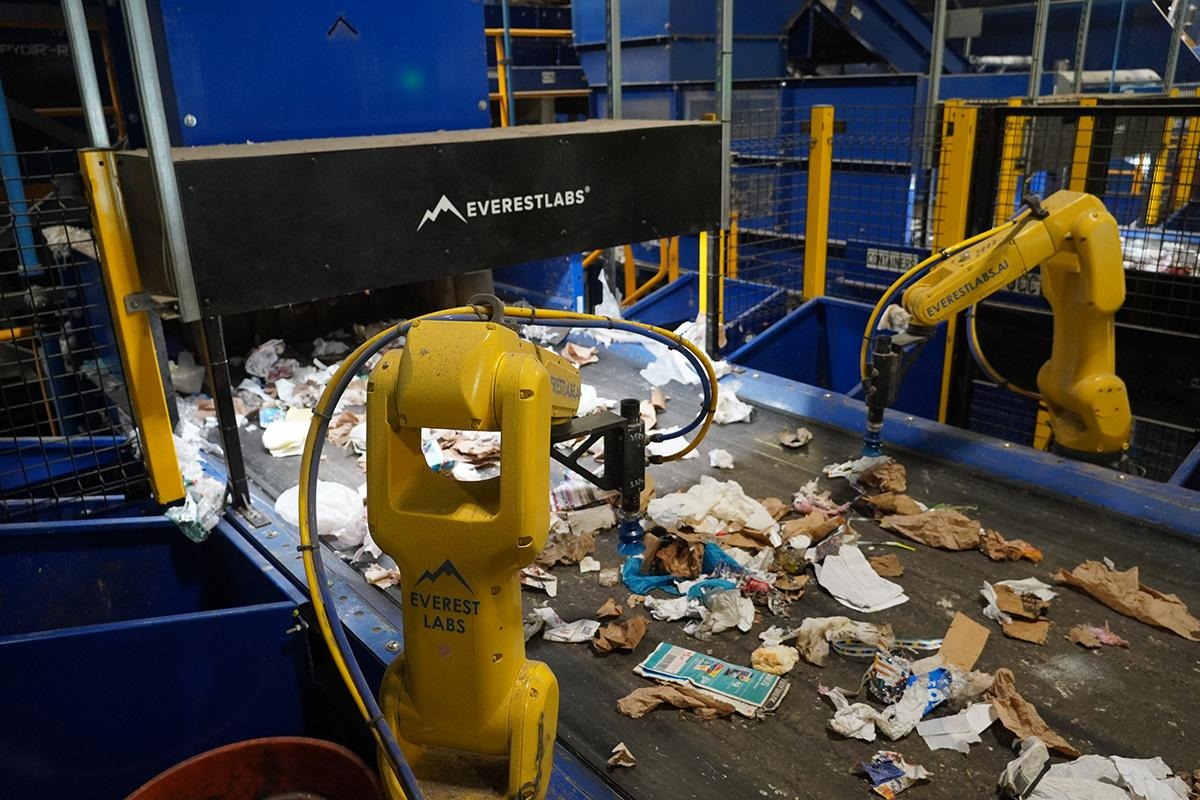
At EverestLabs, we made the opposite bet from AMP. We build Physical AI for the facilities operators already own. We build robots that didn't need major plant upgrades and fitted in the same tiny spaces reserved for manual sorters. I think brownfield is where most of the value will be created this decade, for four reasons.
The work comes to the robot. A conveyor gives AI a defined place to see material and a robot a defined place to act. The objects are unpredictable, but the workflow is repeatable. That is exactly why Anthropic rates the task E2.
Every pick has a price. Unlike most of the occupations in the study, sorting produces a saleable output. A recovered UBC (used beverage cans) or PET bottle is commodity revenue. The business case is not just labor replaced. It is value recovered.
Operators can start on one line. A plant can target a specific recovery gap, measure the result over operating shifts and expand. No one has to wait for a new MRF to be financed, permitted and built.
The robot is only part of the product. What keeps a system performing is knowing what is being missed, placing automation where it pays, and keep it running 24/7. That is why we are extending from robotic sorting to plant-wide intelligence with Navigator.
Anthropic's 0.3% cost-competitiveness figure is a useful reminder: capability is not the hard part anymore. Economics is. Recycling has a head start because every pick earns revenue, not just saves cost.
Anthropic has given the industry a valuable, evidence-based map of where robots can work and why most of that work is not yet economically viable. It correctly puts recycling near the front of the line.
Where it falls short is in who it points to. The company it cited has moved from selling robots to owning and operating MRFs. The real test of Physical AI in recycling is happening on existing lines, shift after shift, measured in recovered material and plant performance. That is where the next phase will be won.