

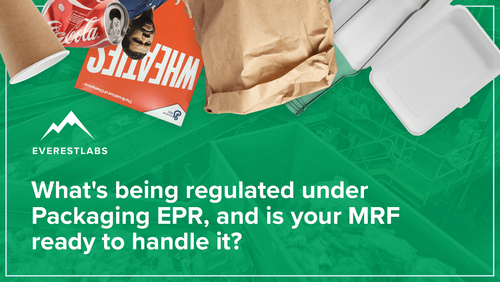
Extended Producer Responsibility (EPR) is recycling legislation that requires producers to manage their packaging's end-of-life. This means that packaging producers will be held financially and operationally responsible for the recovery and recycling of their packaging. The main goal of EPR is to reduce waste by increasing the recovery of recyclable materials. To ensure this is properly and successfully carried out, states are adopting a minimum recyclables list, a list of materials that producers are required to fund the collection and recycling of. It is essential for material recovery facilities (MRFs) to know and understand this list and efficiently recover these materials. This is vital not only for the success of Extended Producer Responsibility (EPR) but also for MRFs to achieve the higher recovery rates mandated by EPR.
Every jurisdiction that has enacted EPR must establish a minimum recyclables list. This is a jurisdiction-specific list of materials that must be collected through commingled curbside recycling and can be recycled mechanically at a MRF. All of the jurisdiction's recycling programs will be required to collect and process the items on this list to establish a basis for consistent streams and recycling practices. Materials added to the minimum recyclables list usually have adequate collection availability, are sortable at MRFs, and have end-market value. There is also an additional materials list that includes materials that can be recycled through collection centers at depots, drop-off centers, or other means.
Having a uniform minimum recycling list is expected to dramatically improve jurisdiction wide recycling rates. Currently, accepted lists of materials for recycling change from municipality to municipality. Therefore, if you drive 15 minutes to a different town, for example, the types of materials that are accepted for recycling could be different from where you just came from. This creates a lot of confusion and a lot of contamination in the recycling stream. Having a uniform list of recyclable materials will reduce consumer confusion about what they can place in their recycling bin and will bolster the recycling rate and decrease contamination. A standardized list will also help stabilize reprocessing these materials and create better end markets for these materials.
Although the types of materials included on these lists vary from jurisdiction to jurisdiction, here are some materials that we have seen included in multiple lists so far:
This is not a comprehensive list but provides a few examples of materials that will be included in minimum recyclable lists in jurisdictions that have enacted or are enacting EPR.
Although many of these materials are chosen due to a MRF's capability to effectively recover them, there may still be items on the list that your facility does not currently process. In addition, MRFs have to be equipped to handle the increased recovery standards set by EPR.
Currently, MRFs are setup to recover based on material type (PET, HDPE, etc) and not packaging type (bottles, clamshells, tetrapak, etc). Optical sorters and eddy current separators are not particularly good at classifying different packaging (for example, to an optical sorter a PET clamshell or a PET water bottle is the same, labels confuse them, and they can't see black). In addition, they are also not good at keeping up with evolving packaging which will be crucial under EPR. Equipment upgrades to your facility, like incorporating AI and robotics, are a way to capture all required materials, decrease contamination, and drastically increase material recovery rates.
Measurement, verification, tracking and improving collection and sortation are key features of EPR legislation. Manual sampling is inaccurate and existing sorting methods cannot adapt to changing recyclable material list - especially one based on packaging - easily. AI and robotics can help.
Measurement/verification of things like recovery rates and material characterization is currently carried out manually in a MRF, often resulting in cumbersome, inaccurate and statistically insignificant data collection. To be successful under EPR, data collection has to be efficient and accurate. AI is not only able to provide highly accurate data but it does so continuously. This will be highly valuable when reporting on recovery rates for various packaging and also contamination levels.
AI driven robotics is the only solution today that can evolve with new packaging designs and changing accepted material lists. EverestLabs's AI infrastructure is designed to adapt to new material and packaging types subject to EPR programs within days to weeks of observing the new object type. EverestLabs can identify 50+ classes of objects, including plastics, metals, aluminum, glass, paper, cardboard, tin, styrofoam, and tetrapak. It is constantly updating to include new material classes that your facility is not yet recovering. This ability will be especially important as the minimum recyclables lists are not static and are expected to evolve over time to continue to support an effective recycling system.
EverestLabs' robotics can enhance the recovery of recyclable materials from current sorting facilities without requiring expensive retrofits. This offers MRFs a chance to meet the elevated material recovery standards set by EPR legislation. Recycling robots can be placed on existing conveyor belts to augment the current sorting processes and deliver higher recovery rates than traditional sorting methods. Check out our deployment webinar, which highlights how quick and seamless the installation and deployment process is.
Adding AI and robotics to your facility, such as those offered by EverestLabs, provides a robust solution to help MRFs recover all materials with minimum recyclables lists. This technology enhances sorting efficiency and material recovery rates, enabling MRFs to comply with EPR requirements without significant retrofitting costs. One of the best parts? You can achieve payback in as little as 3 months.
Contact us to learn how EverestLabs can help your facility meet EPR compliance requirements, or email us at hello@everestlabs.ai.