
For most of the last decade, the industrial answer to “we can’t see our operation” was to add sensors and put charts in front of the operator. We instrumented plants, shipped dashboards, and called it intelligence. It wasn’t. A dashboard is a read-only view of the past. It tells an operator what happened; it does nothing on its own. The human still has to notice the chart, interpret it, decide, and act — under time pressure, across shifts, while ten other things compete for attention. We improved observability and left the hardest part exactly where it was.
When we listened to operators, they said it plainly: they did not want more data. They wanted the plant to do something with it.
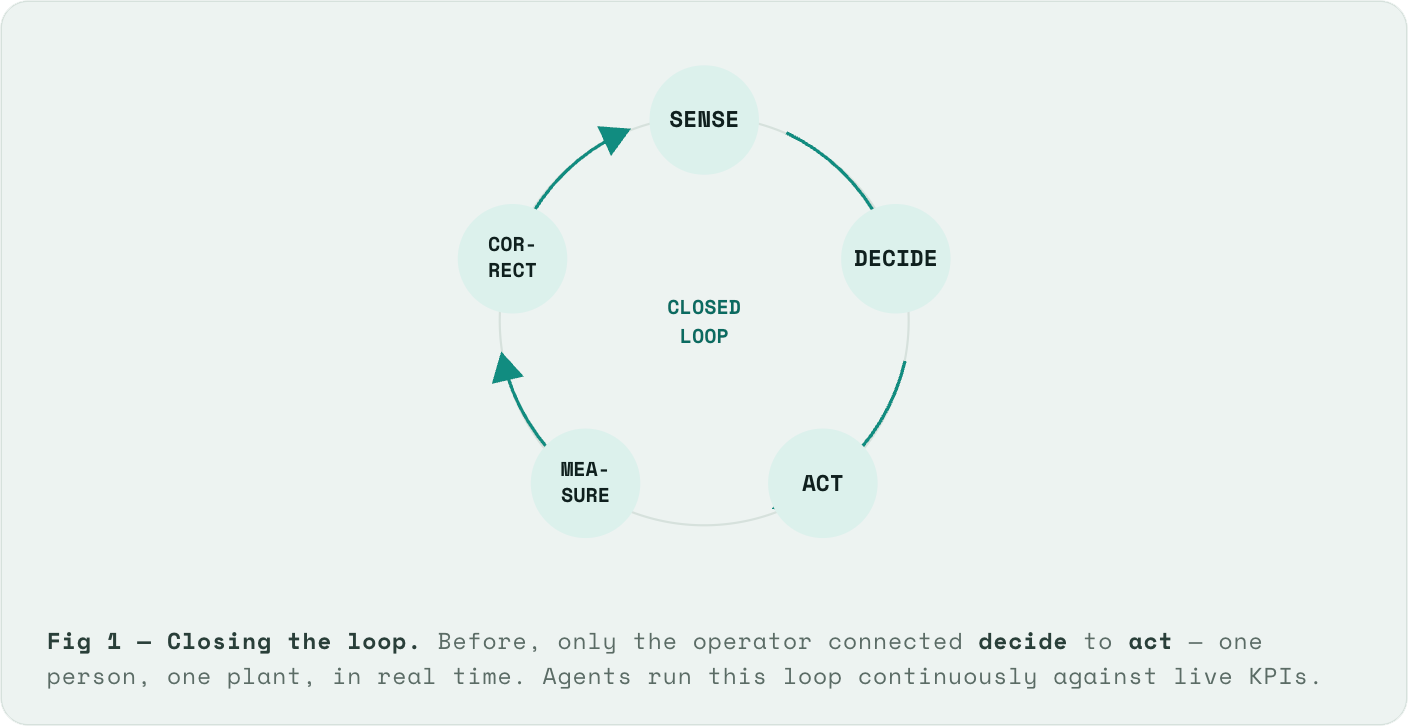
The most useful framing we found is an old one from control theory. Any well-run process is a loop: sense → decide → act → measure → correct, repeated continuously. The quality of the operation is really the quality of that loop.
In a materials facility, the only general-purpose element in that loop has historically been a person. Sensors could sense and machines could act, but the deciding — connecting what is happening to what should happen next — lived entirely in an operator’s head. That is why the system is reactive by nature: there is only so much loop one person can close, in real time, for an entire plant. Agentic AI is, at bottom, a way to close that loop in software — not to replace the operator’s judgment, but to give the plant its own.
The instinct is to build one large model that “runs the plant.” That is the wrong shape, because the plant’s decisions live at completely different timescales and authorities. Reading a scene happens in milliseconds. Optimizing a line plays out over minutes. Answering an operator’s question is a conversation. No monolith serves all three well — this is a separation-of-concerns problem before it is a modeling problem.
So the architecture is layered, and the intelligence layer is a set of specialized agents, each owning a slice of the loop: a vision agent reading the scene and flagging anomalies; a fleet agent tracking how the robots and equipment themselves are performing, so degradation is seen coming; an automation agent that reaches into the equipment and adjusts it, turning a decision into a physical change on the line; and a data agent that answers an operator’s questions grounded in the live state of their plant, not generic answers.
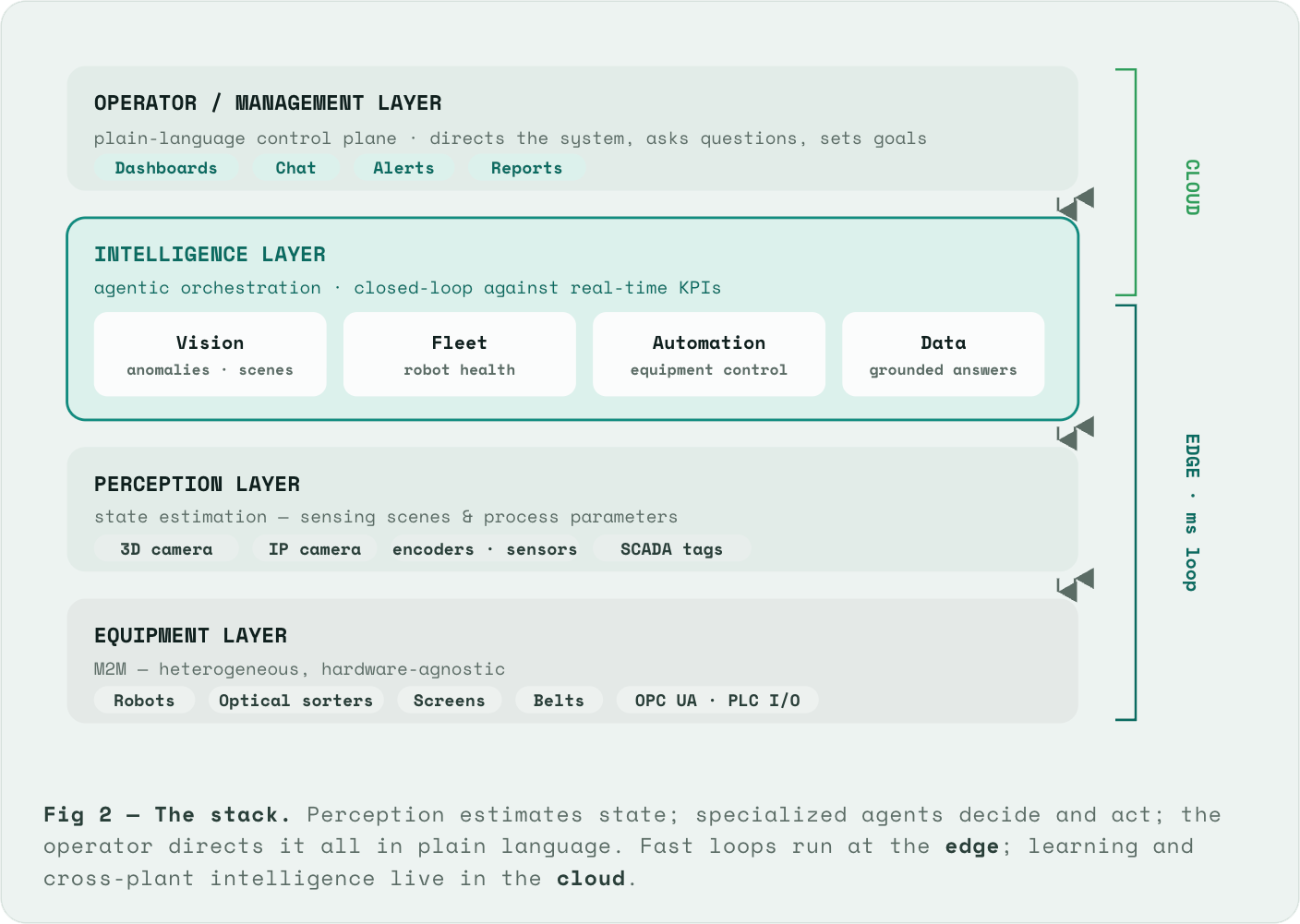
Two design choices matter more than they look. The latency-critical parts of the loop run at the edge, co-located with the machines, where milliseconds decide whether an action lands; the learning and cross-plant intelligence live in the cloud, where scale and history matter. And the whole system is hardware-agnostic by design: it speaks to whatever robots, sorters, and controls are already on the floor through standard industrial interfaces — OPC UA, SCADA, PLC I/O — because nobody gets to demolish a working plant to install intelligence into it. The integration surface is the product as much as the models are.
That is the whole shift, in one line: the industry has plenty of reactive automation — machines that repeat a fixed motion regardless of what arrives. What it has never had is agentic orchestration — a system that runs the plant against goals and adapts as the material changes. The first is a machine following instructions. The second is a plant that manages itself, with a human steering rather than operating.
But every agent in this stack is only as good as what the perception layer can resolve — and the floor of a materials facility may be the most hostile visual environment in all of industry. That is a problem worth taking seriously on its own terms.