

Modern vision models are trained on the internet, and the internet is a curated place. Its images are centered, well-lit, redundant, and already labeled by the act of being posted. The web holds millions of clean photographs of a cat. It holds almost nothing that looks like a crushed, label-torn container tumbling past a camera at speed, half-buried under a hundred other objects, in an arrangement that will never recur.
That second picture is not an edge case in a materials facility. It is every frame. The floor of a recovery plant is, in a real sense, the anti-internet: endless variation, no two moments alike, objects deformed and dirty and overlapping, streaming by faster than a person can point. It is the anti-ImageNet.
Which leads to the fact that shapes everything we do: the data that would teach a machine to see this world does not exist to be downloaded. It has to be earned — captured on real lines, across an enormous number of operating hours, and turned into verified labels no one else has. That earned, verified record is what machine learning calls ground truth.
Break the difficulty into its parts and you get a catalog of things that individually make computer vision hard, all present at once.
Extreme intra-class variation. A single material class appears in wildly different shapes, colors, and states of damage. The model has to learn the concept of a material, not the appearance of any one instance — closer to open-set recognition than tidy
Severe long-tail imbalance. Some materials pour through constantly; others are rare. And the rare ones are often exactly the ones that matter most — the highest-value item, or the hazardous one you must never miss. A detector trained naively on natural frequencies learns to ignore precisely what you most need it to catch.
Dense, overlapping scenes. Many objects crowd a single frame, layered on top of one another. This is where standard instance segmentation and non-max suppression strain: heavy occlusion means the “right” answer is often a partial object, and boxes that overlap by design.
A hard real-time budget. None of this can be pondered. Sensing, inference, motion planning, and actuation must all complete in the low-millisecond range — because the object has to be resolved and reachable before it travels out of the arm’s window. Accuracy you can’t deliver inside the budget isn’t accuracy; it’s a research result.
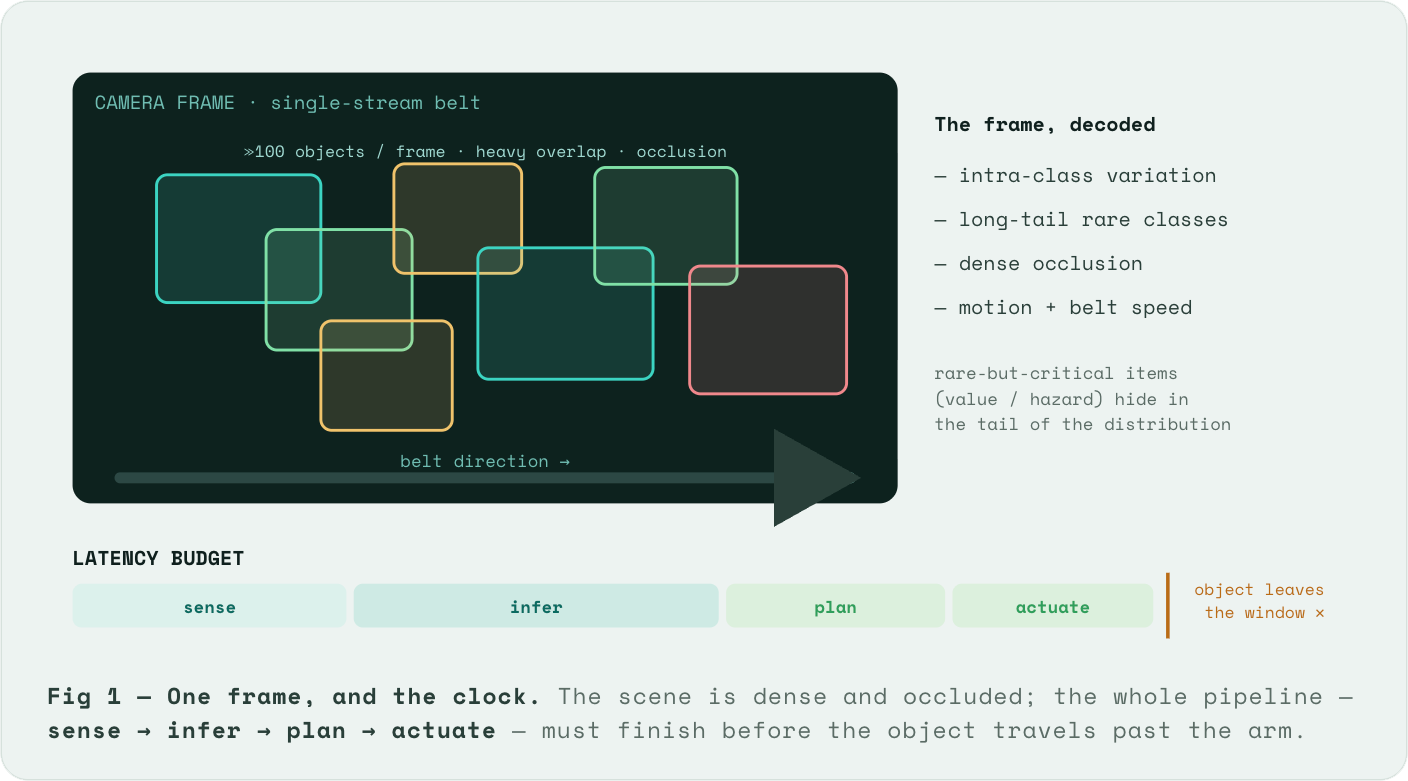
Some of these fight each other. The most direct lever against long-tail imbalance, for instance, is to manufacture what the world won’t supply enough of — using synthetic generation to create examples of the rare classes, paired with active learning to keep labeling effort aimed at the frames the model is most confused by.
Seeing is the easier half. Perception here is worthless unless it can act, and acting on a moving stream is its own discipline. It means driving robots you didn’t build — different kinematics across 6-axis, delta, and SCARA arms — behind one common motion interface, so the model reasons about picks, not about any particular vendor. It means end-of-arm tooling that changes how it grips depending on the target: vacuum and venturi for film and containers, magnetic for ferrous, mechanical grippers for the awkward rest. And it means deciding what to pick first.
That last point is the quiet one. At capacity you cannot grab everything, so the arm is continuously solving a small online optimization: of everything reachable in the next window, which pick returns the most value per second? A sorting arm isn’t executing motion — it’s scheduling scarce actuation against a live estimate of value and risk. Get that prioritization right and the economics change; get it wrong and you’re busy picking the cheap thing while the valuable thing rides past.
Here is what ties it together. Every deployment, on every line, adds to the ground-truth record. More ground truth sharpens perception; sharper perception makes picking more accurate and more valuable; better results justify more deployments. Around it goes — a data flywheel, not a static dataset.
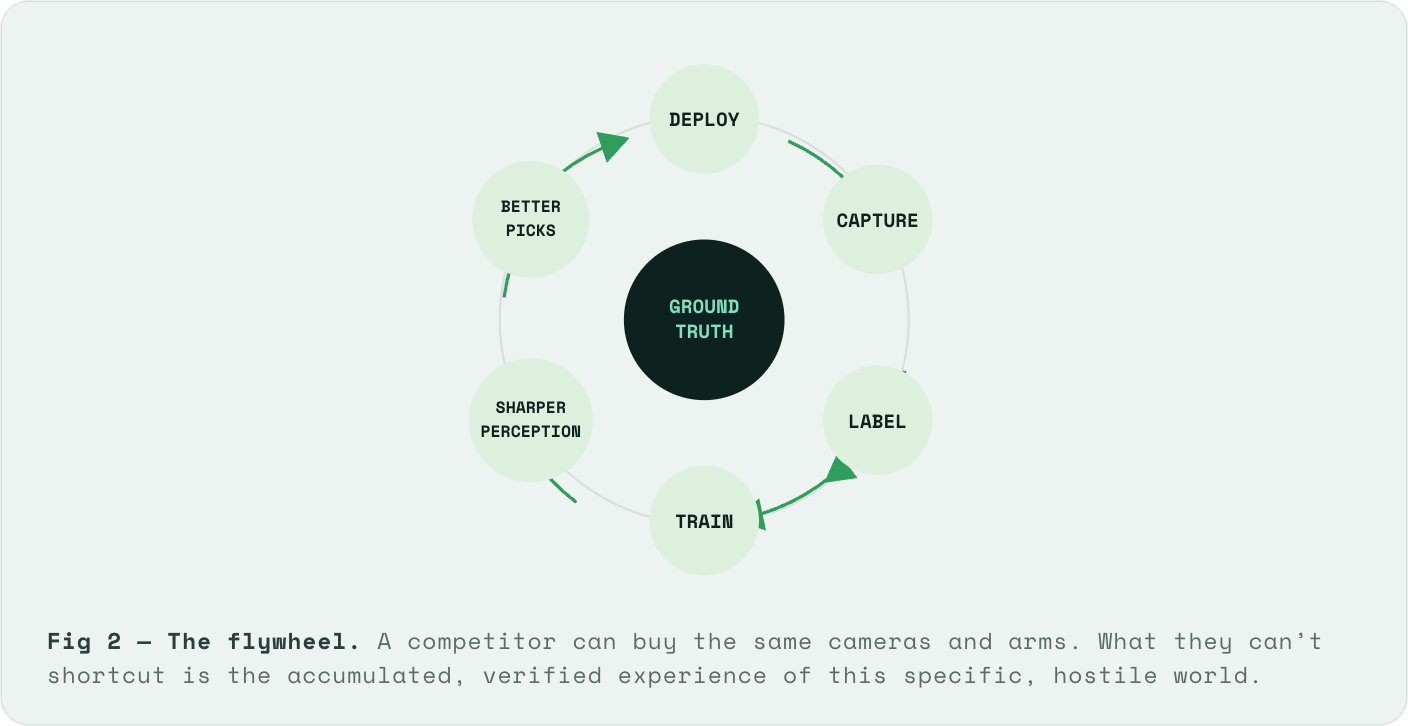
A competitor can buy the same cameras and the same robots. What they cannot do is shortcut the miles of belt — the accumulated, verified experience of a world that isn’t online and can’t be scraped. Which is the part worth sitting with: the hardest thing about the problem is exactly what makes the lead durable. The difficulty isn’t the obstacle. It’s the moat.