

Everything physical you own began as material that was either dug out of the ground or recovered from something already made. Beneath the multi-trillion-dollar economy of things the world manufactures sits an even more fundamental layer that supplies the raw material for all of it: plastics, fiber, metals, aggregates — flowing from virgin extraction on one side and recovered, circular streams on the other.
We call one half of that system “waste management.” That is a category error, and it is the most important one to correct before anything else makes sense. The bottle you set out on the curb is not garbage being disposed of. It is feedstock being routed. Recovered aluminum, recycled resin, and reclaimed fiber are raw-material supply. Automakers already source recycled aluminum recovered from used beverage cans; regulators are writing minimum recycled-content requirements into law. The boundary between “recycling” and “supply chain” has quietly dissolved.
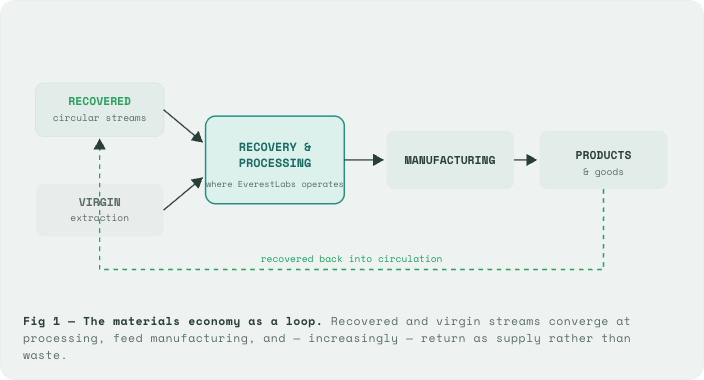
Which makes the next fact hard to believe: this system runs almost entirely open-loop. A systems engineer would recognize the symptom immediately — a process with no observability layer and no closed feedback. There is no live, trustworthy picture of internal state, so there is nothing reliable to control against.
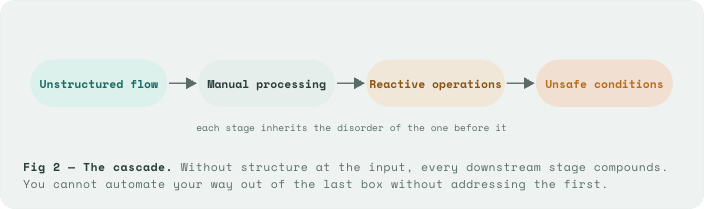
Talk to enough facility operators and the same three problems surface everywhere. The first is labor: plants frequently cannot run the lines they already have, because the work is hard, hazardous, and chronically short-staffed. Capacity sits idle not because machines are missing, but because the people to run them are.
The second is quality. Output drifts shift to shift and operator to operator, because so much of the process still depends on human judgment applied in real time to a stream that never looks the same twice.
The third is the one underneath the other two: the operational blind spot. Most facilities cannot say, in the moment, what is on their belts, what they are recovering versus losing, or why today’s result differs from yesterday’s. In control terms, the human operator is the state estimator — the only element turning raw observation into a decision — and there is no historian capturing that decision so the plant can learn from it later.
For a long time, the pressure to fix this was diffuse. It no longer is. Material security has become a strategic concern rather than an environmental footnote — manufacturers increasingly want reliable, lower-carbon, domestically recoverable inputs instead of exposure to volatile virgin markets. Regulation is pulling recycled content upward. And the economics of recovery are becoming real enough that the material a facility misses is no longer a rounding error; it is revenue left on the belt.
All of that pressure is arriving faster than the industry can hire its way out of, or instrument its way out of, with the tools it has.
All of that pressure is arriving faster than the industry can hire its way out of, or instrument its way out of, with the tools it has.