

This industry has been disappointed by robots before. Operators who ran the first generation of sorting automation can recite the failures from memory: cups that clogged, arms that missed as often as they hit, maintenance that ate the savings, retrofits that cost more than the robot itself. It would be easy to conclude the technology wasn’t ready. The truer conclusion is that the wrong machine was chosen for the job — spectacle over reliability, speed and complexity over success and simplicity.
So it is worth doing what a systems architect does before committing to any critical dependency: survey the design space honestly, on the axes that actually matter for a fixed, high-throughput station running an unstructured stream around the clock.
Four archetypes dominate the field — plus one that dominates the headlines.
The delta, the fast parallel “spider,” is a marvel of speed: three arms slung from an overhead frame, flinging light parts across a clean cell hundreds of times a minute. Its gifts are also its limits. Reach and orientation are constrained, so it tends to pick by brute vertical force rather than approaching an object the way the object is actually lying. Its linkages are exposed — exactly the parts a stream of film, paper, and dust likes to foul. Superb in a packaged-goods line where every item is identical and presented the same way; poorly matched to chaos.
The SCARA is quick and repeatable within a plane — the workhorse of assembly and palletizing — but it is built for structured, top-down motion into known positions, not for tracking a tumbling, arbitrarily posed object on a moving belt.
The gantry, or Cartesian system, offers a large workspace and high payload with rigid precision, which is why it moves heavy, bulky material well. But it is construction-heavy to install, slow to re-task, and clumsy at the fast, individual, dynamic tracking that sorting demands. It is material handling, not dexterous picking.
And then the humanoid — the machine the industry is currently fascinated by. The promise is generality: one body that does everything a person does. But a sorting station does not have a human-shaped problem. It is a fixed post performing one motion, millions of times, at a duty cycle and a price point where today’s humanoids are immature — expensive, comparatively fragile, hard to keep running safely at line speed for years. Putting legs and a torso on a conveyor solves a form-factor problem the line does not have.
Which leaves the six-axis articulated arm — the unglamorous workhorse of heavy manufacturing for decades. Six degrees of freedom mean it can reach an object from almost any angle and match its orientation, so it can pick things that are deformed, overlapping, and lying however they happen to land. Its motors are internal and sealed; there are no exposed joints for the stream to jam. It installs in hours with little retrofit and mounts over, beside, or above almost any belt. It is, quietly, the machine that already works.
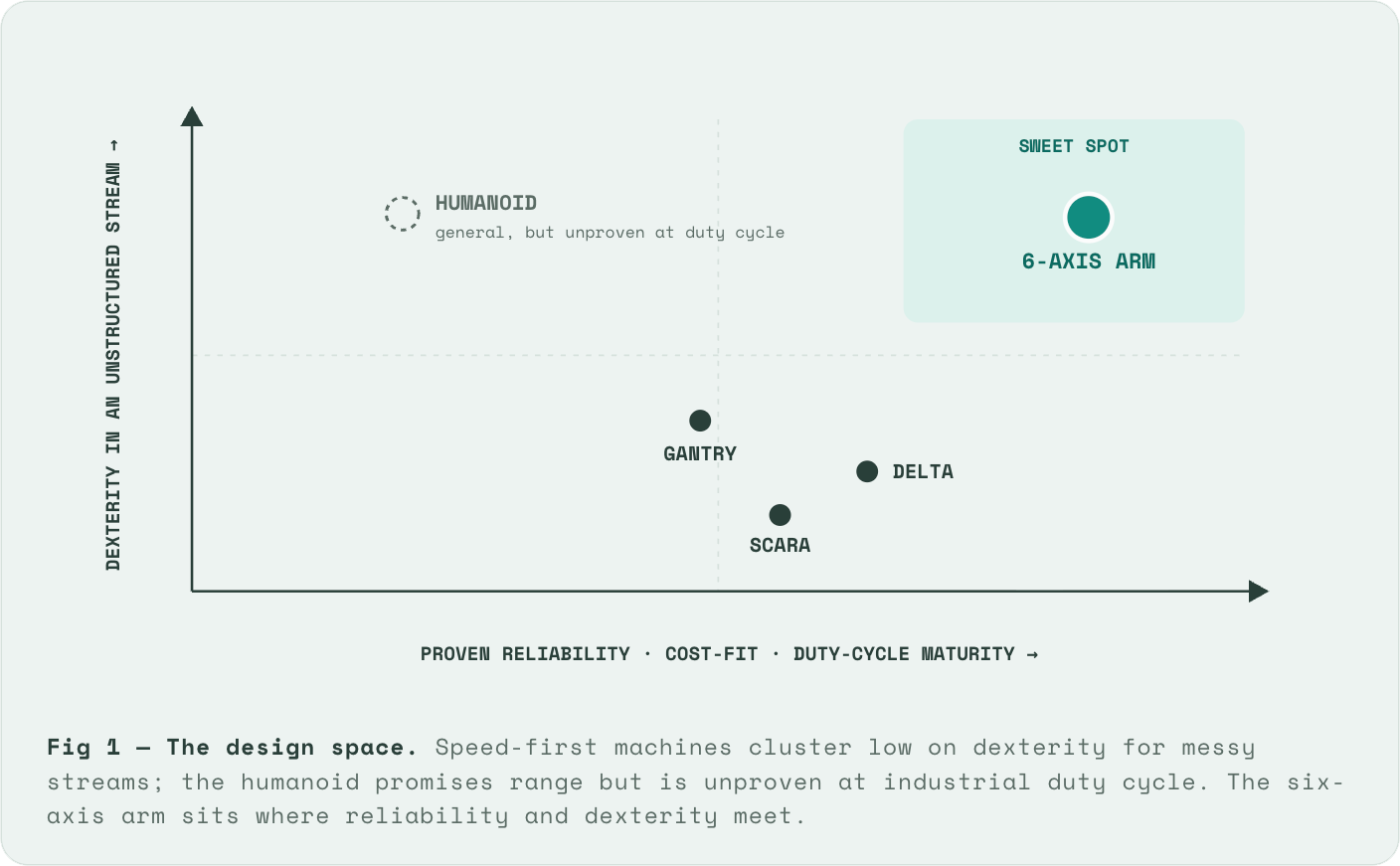
Reframe the comparison the way a CTO evaluates any critical dependency: not by peak spec, but by risk-adjusted total cost across years of uptime.
Pose freedom is pick success. Six degrees of freedom let the arm approach along an object’s natural line and lift it cleanly, rather than stabbing straight down and hoping. On a variable stream, that is the difference between production-grade recovery and a machine that misses about as often as it succeeds. And a clean pick profile lets the arm carry and release an object into a chute in one motion — no dwell, no fighting film-wrapped suction cups — which is as much a reliability feature as a speed one.
Sealed kinematics are uptime. Because the arm descends from decades of heavy-duty manufacturing, its failure modes are known, its motors are internal and protected, and its MTBF is measured in a vocabulary the whole supply chain shares. There are no exposed linkages to clog and wear. Serviceability is a solved problem, not a research project.
Maturity is cost. A six-axis arm is a commodity produced by every major industrial OEM, with a deep parts-and-service ecosystem behind it: minimal construction to install, high duty cycle, predictable maintenance, payback measured in months rather than years. You are buying a known quantity, not betting on a prototype.
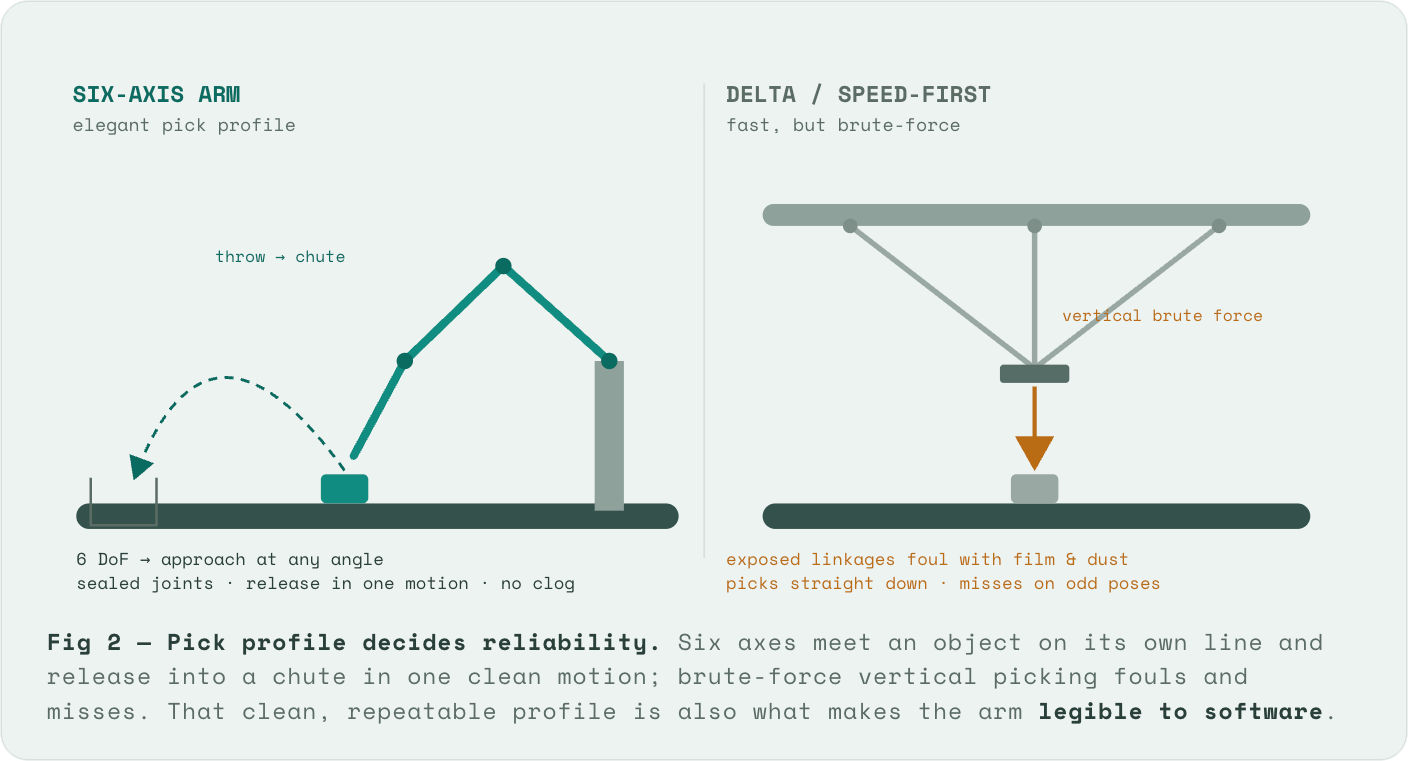
Here is the part that matters most for where this is going. The six-axis arm is not only the most reliable actuator — it is the most legible one, and legibility is what lets software run it well.
An articulated arm presents a clean, deterministic control interface. Its inverse kinematics are well-posed, its working envelope is exactly known, and a commanded motion produces a repeatable result. So the agent orchestrating the line can reason about the arm precisely — plan a pick, sequence it against others, predict when the end-of-arm tool will arrive — inside a tight, knowable actuation budget. A humanoid’s behavior, by contrast, is comparatively stochastic and hard to model; you cannot close a fast control loop around a body you can’t predict.
Legibility is also responsiveness. Low-latency, deterministic motion gives the perceive–decide–act loop a stable actuation window to plan against, so the automation agent can commit to the highest-value reachable pick and trust the arm to land it in time.
And it compounds into data. Because the arm is a commodity, the software can treat it as an interchangeable actuator across OEMs — hardware-agnostic by design — and standardize the fleet on one well-characterized body. Every cell then emits uniform, comparable telemetry: the same motion signatures, the same self-reported pick-success signal from an integrated sensor, the same failure vocabulary, across every plant. Heterogeneous or bespoke robots fragment that signal; a standard arm turns each deployment into a clean data-generating node that sharpens the models for the entire fleet — and lets multiple arms split and coordinate work on a single line. The metal is interchangeable. The intelligence is the moat.
The future of robotics in the materials economy is not a more human-shaped machine. It is a more intelligent system wrapped around the most reliable actuator we already have — proven metal, made extraordinary by the software commanding it. The boring robot wins because, in a plant that has to run every hour of every day, boring is exactly what reliability looks like.